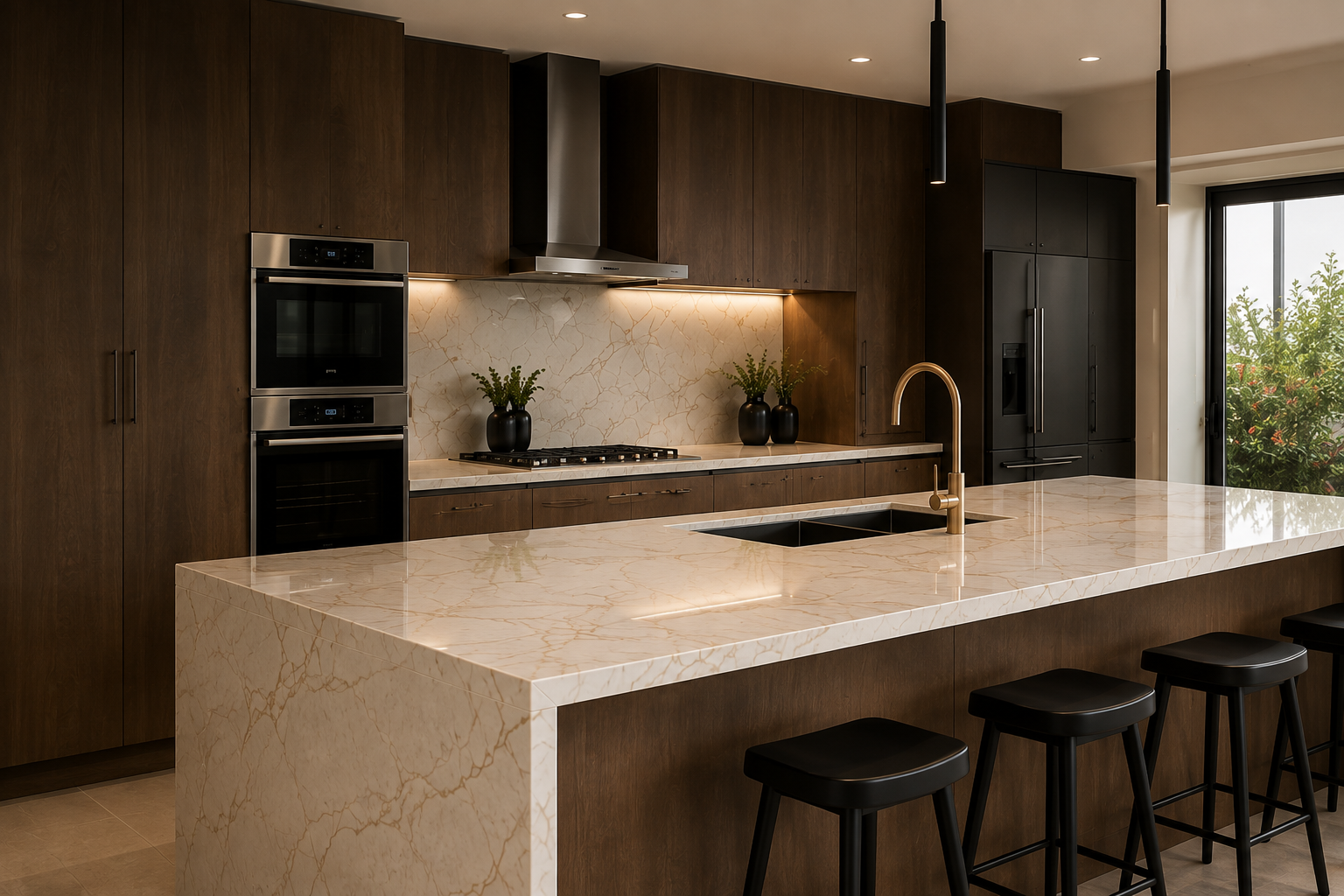
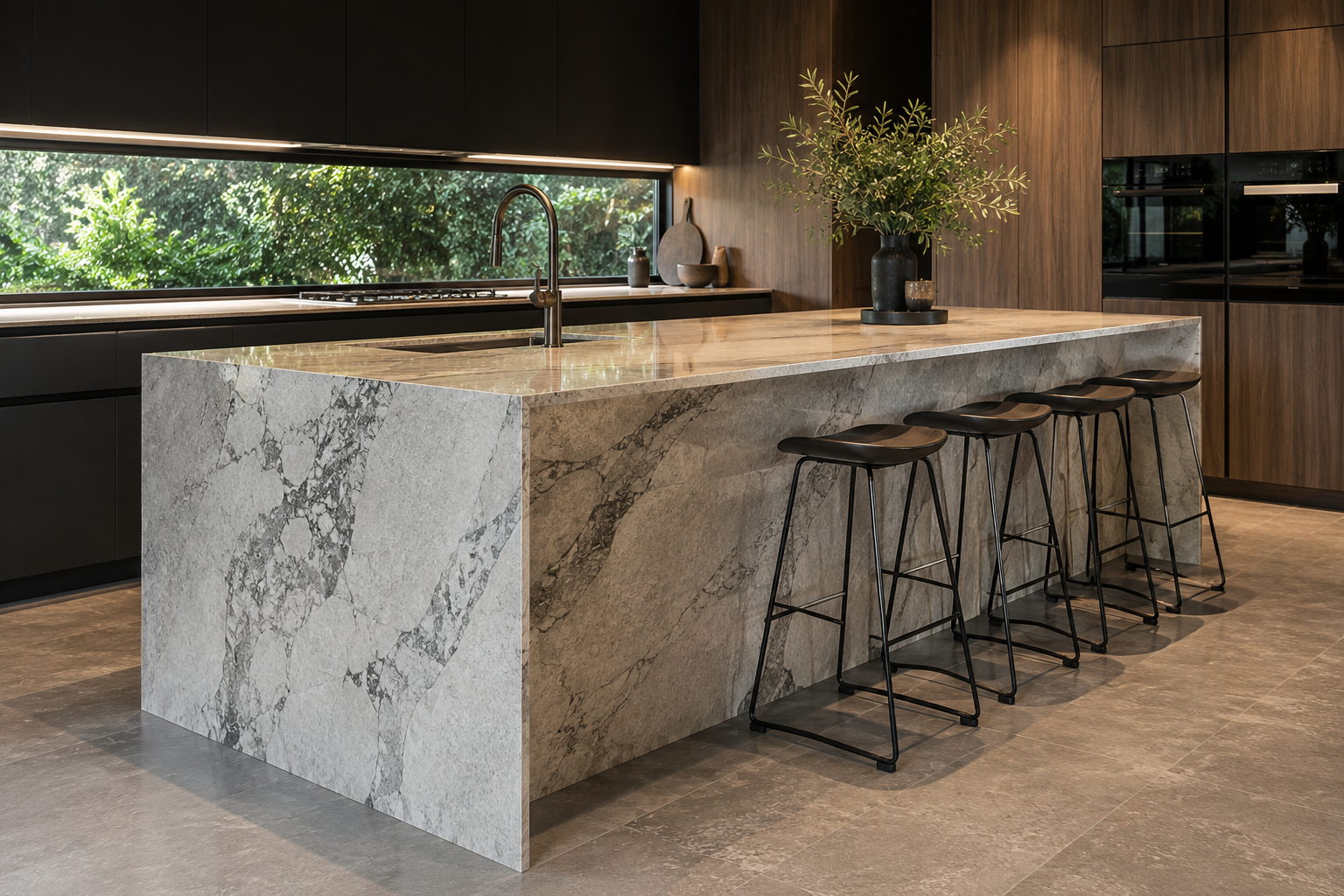
What Is a Waterfall Edge Benchtop?
A waterfall edge benchtop is a design where the stone from a horizontal benchtop continues vertically down the exposed side of an island, creating a continuous and architectural look.
Instead of the stone simply stopping at the edge of the benchtop, it continues down the side of the island towards the floor.
Waterfall edges are most commonly seen on kitchen islands, but the same design approach can also be used for bathroom vanities, and other custom stone surfaces.
At Cyrus Stone, we design, fabricate and install custom stone surfaces across Melbourne, providing an end-to-end service from the initial consultation and measurement through to fabrication, installation and final clean-up.
What Is a Waterfall Edge?
A waterfall edge is created when the stone surface of a benchtop continues vertically down the exposed side of the cabinetry.
Unlike a standard benchtop, where the stone finishes at the edge of the cabinet, a waterfall edge allows the material to become part of the overall architecture of the island.
The result is a more continuous and substantial appearance, particularly when the island is positioned where it can be seen from several areas of the home.
What Does a Waterfall Edge Look Like?
A waterfall edge can be designed in several ways depending on the layout of the space and the look the homeowner wants.
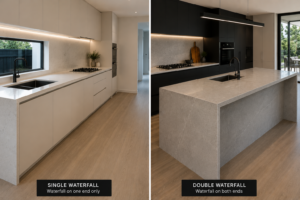
Single Waterfall
A single waterfall continues down one exposed end of the island.
This can be a good option when one side of the island is more visible than the other, or when the homeowner wants the waterfall detail without covering both ends.
Double Waterfall
A double waterfall continues the stone down both exposed ends of the island.
This creates a more symmetrical and substantial appearance and can work particularly well when the island is visible from multiple directions.
Why Are Waterfall Benchtops So Popular?
The main reason homeowners choose a waterfall edge is visual impact.
A standard benchtop creates a horizontal work surface. A waterfall edge allows the stone to continue down the side of the island, making the island itself a stronger architectural feature.
A well-designed waterfall can:
- Create a strong focal point
- Make the island feel more substantial
- Showcase the colour and movement of the stone
- Cover exposed cabinetry
- Create a cleaner and more continuous appearance
- Give the kitchen a more refined, finished look
A waterfall edge is primarily a design feature rather than a functional necessity.
It does not fundamentally change how the benchtop is used. Instead, it changes how the island looks and how the stone interacts with the rest of the room.
What Makes a Waterfall Edge Look Professional?
The finished appearance of a waterfall edge depends on much more than simply attaching a piece of stone to the side of an island.
Accurate measurement, careful fabrication, joint detailing, stone layout, vein alignment and precise installation all contribute to the final result.
This is particularly important at the point where the horizontal benchtop meets the vertical waterfall.
A poorly planned joint can make an otherwise beautiful stone look disconnected.
A well-executed waterfall should feel intentional, balanced and visually continuous.
At Cyrus Stone, we consider these details throughout the process, from material selection and measurement through to fabrication and installation.
Mitred Waterfall Edge vs Shadow Gap
There are several ways to detail the transition between the horizontal benchtop and the vertical waterfall.
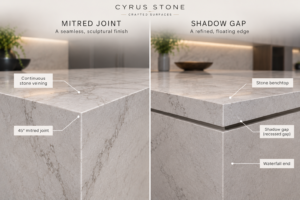
Two options commonly considered are a mitred joint and a shadow-gap detail.
Mitred Waterfall
A mitred waterfall typically uses two pieces cut at approximately 45 degrees and joined at the corner.
This creates a clean transition between the horizontal and vertical surfaces and can also create the appearance of a thicker slab.
A mitred edge can be particularly effective when the stone has strong movement or veining that you want to flow from the benchtop onto the waterfall.
Shadow Gap
A shadow-gap detail creates a deliberate small separation between the horizontal benchtop and the vertical waterfall.
Instead of making the transition appear completely joined, the small gap creates a subtle shadow line.
The result is more architectural and minimalist.
Both approaches can look excellent. The choice depends on the design, material, proportions and the homeowner’s preferred aesthetic.
Why Does Vein Matching Matter?
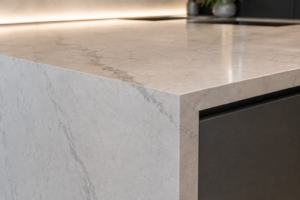
One of the details that can make a major difference to a waterfall edge is the way the stone’s natural pattern flows across the surfaces.
Imagine a stone with strong veins running across the benchtop.
If those veins suddenly stop at the edge and appear in a completely different direction on the waterfall, the result can look disconnected.
When the slab allows it, Cyrus Stone takes the layout and veining into consideration during fabrication so that the pattern flows as naturally as possible from the benchtop onto the waterfall.
The exact level of matching depends on the particular slab and its natural pattern. Natural stone is unique, so a perfect match cannot always be guaranteed.
However, when the material allows it, thoughtful vein planning can make the finished waterfall significantly more visually cohesive.
What Materials Can Be Used for a Waterfall Edge?
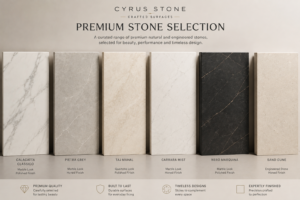
A waterfall edge is not limited to one particular type of stone.
The right material depends on the look, performance requirements, maintenance preferences and budget of the project.
Depending on the project and applicable Australian requirements, Cyrus Stone can work with materials including:
- Natural stone
- Marble
- Granite
- Quartzite
- Porcelain
- Sintered stone
- Other compliant stone surfaces
Material selection should happen before fabrication because the characteristics of the chosen material can influence the design, layout and fabrication process.
A Note About Engineered Stone in Victoria
Victoria introduced a ban from 1 July 2024 on the manufacture, supply, processing and installation of engineered stone benchtops, panels and slabs.
Under the current Victorian definition, engineered stone is an artificial product containing 1% or more crystalline silica by weight and made by combining natural stone materials with other chemical constituents.
WorkSafe Victoria excludes porcelain and sintered stone products that do not contain resin from the definition of engineered stone.
For any specific product, its current composition and supplier documentation should be checked rather than relying only on a product name or marketing description.
What Thickness Is Best for a Waterfall Benchtop?
There isn’t one thickness that is right for every project.
Cyrus Stone can work with different thicknesses, including 6mm, 12mm, 20mm and, where appropriate, 30mm.
Around 20mm is a common choice for benchtops.
If a homeowner wants a visually thicker edge, a mitred build-up can be used to create a thicker-looking profile without necessarily using a solid piece of stone of that thickness.
This gives homeowners more freedom to achieve the visual weight they want while still working with the characteristics of the selected material.
Does a Waterfall Edge Cost More?
Generally, yes.
A waterfall edge requires additional material and additional fabrication compared with a standard benchtop edge.
The final cost can be influenced by:
- The size of the island
- Number of waterfall ends
- Material selected
- Slab size and layout
- Mitred fabrication
- Edge details
- Cut-outs and other fabrication requirements
- Installation complexity
A waterfall also requires more planning and fabrication than simply finishing the edge of a standard benchtop.
So the additional cost isn’t just for the extra piece of stone. It also reflects the additional work required to measure, fabricate and install the finished design correctly.
Is a Waterfall Edge Worth It?
For the right space, it can be.
A waterfall edge is particularly effective when the island is positioned where it can be seen from multiple areas of the home.
If the island is the visual centre of an open-plan kitchen or living area, continuing the stone down the side can make a significant difference to the overall appearance.
However, a waterfall isn’t automatically the best choice for every project.
If the side of the island is hidden, the additional stone may not provide much visual benefit.
The decision should come down to the layout, visibility, material, budget and the look you want to achieve.
At Cyrus Stone, we help homeowners consider these factors before committing to a design.
Can a Waterfall Edge Be Used on Other Surfaces?
Yes.
Although kitchen islands are the most common application, the same design principle can be used anywhere a stone surface is designed to continue vertically.
Examples include:
- Kitchen islands
- Bathroom vanities
- Custom cabinetry
- Other architectural stone features
The principle is simple: if you want a horizontal stone surface to continue vertically, a waterfall-style detail may be possible.
The exact construction depends on the space, dimensions, material and design.
What Should You Consider Before Ordering a Waterfall Edge?
Before choosing a waterfall, consider five important things.
1. How Visible Is the Island?
The more visible the island is from the living and dining areas, the more impact the waterfall can have.
2. What Stone Are You Choosing?
The pattern, veining and characteristics of the slab can affect how impressive the finished waterfall will look.
3. Do You Want the Veins to Flow?
If your stone has strong movement or veining, discuss the desired layout before fabrication.
4. Which Edge Detail Do You Prefer?
A clean mitred transition and a shadow-gap detail create very different visual effects.
5. Is the Rest of the Room Ready?
Because the waterfall continues towards the floor, having the finished flooring in place before installation can help achieve the intended final appearance.
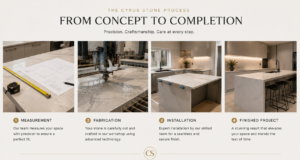
How Does the Cyrus Stone Waterfall Process Work?
At Cyrus Stone, we provide an end-to-end service designed to make the process straightforward from the first conversation through to installation.
01 — Tell Us About Your Project
Send us photos, approximate dimensions or your kitchen plans.
If you’re still deciding what you want, that’s fine too.
We can discuss your ideas, answer your questions and help you understand which options may suit your space.
02 — Free On-Site Measurement
We can arrange an initial on-site measurement to understand the project and prepare an initial quote.
This measurement is suitable for quotation purposes.
Once the project is approved, we carry out the detailed measurement required for fabrication.
03 — Choose Your Stone
We help you select the material, colour, finish and overall look that suits your space.
Cyrus Stone can source the stone for you, or you can choose to purchase the material through your own supplier.
04 — Detailed Measurement & Fabrication
Once the design and material are confirmed, precise measurements and fabrication planning take place.
Details such as joins, edge profiles, dimensions and vein layout are carefully considered before cutting.
05 — Professional Installation
The fabricated stone is installed accurately and finished carefully.
Where necessary, the installation is levelled and adjusted to achieve the best possible finished result.
06 — Final Clean & Handover
The area is cleaned and the finished stonework is handed over ready to enjoy.
From measurement to fabrication and installation, Cyrus Stone provides an end-to-end service across Melbourne.
Can I Send Photos or Plans for a Waterfall Edge Quote?
Yes.
You can send photos, approximate dimensions, floor plans or kitchen plans to Cyrus Stone.
These details help us understand your space and provide an initial indication of what may be possible and an approximate quote before moving to detailed measurement.
If you’re not sure what information to send, simply send us photos of the space and tell us what you have in mind.
We can guide you from there.
Do I Need to Know Which Stone I Want Before Contacting Cyrus Stone?
No.
You don’t need to have everything figured out before getting in touch.
Choosing a stone is an important part of the process, particularly when the material has strong veining, requires specific maintenance or needs to work with the existing colours and finishes in your home.
Cyrus Stone can help you compare suitable materials and understand the practical considerations before you make your decision.
For example, some natural stones require more care than other materials. Certain natural stones can be more sensitive to staining or acidic substances, so understanding maintenance requirements before choosing the material is important.
Can a Waterfall Edge Be Installed on an Existing Kitchen?
In many cases, yes, although the existing cabinetry, dimensions, flooring and layout need to be assessed first.
A site measurement allows the project requirements to be understood before fabrication begins.
If you’re renovating an existing kitchen, send photos and measurements to Cyrus Stone so the project can be assessed properly.
Waterfall Edge Benchtop FAQs
Is a waterfall edge the same as a standard benchtop edge?
No. A standard edge finishes at the side of the benchtop. A waterfall edge continues vertically down the exposed side of the island.
Can I have a waterfall on both sides of my island?
Yes. A double waterfall can be used when both ends of the island are exposed and the design suits the space.
Does a waterfall edge use more stone?
Yes. Because the stone continues down the side of the island, additional material is required.
Does a waterfall edge require a mitred joint?
Not necessarily. A mitred joint is one option. A shadow-gap detail can create a different architectural appearance.
Can the stone veins continue onto the waterfall?
They can be planned to flow as naturally as possible, depending on the pattern and layout of the selected slab.
Is a waterfall edge suitable for a small kitchen?
It can be. Suitability depends more on the island’s layout, visibility and proportions than simply the size of the kitchen.
What is the most common benchtop thickness?
20mm is a common choice, although Cyrus Stone can work with different thicknesses depending on the selected material and project requirements.
Can I choose natural stone for my waterfall?
Yes. Natural stone can be used for waterfall applications, subject to the material being suitable for the specific project.
Does natural stone require more maintenance?
Some natural stones require more care than other materials. Cyrus Stone can explain the maintenance and protection requirements of your selected stone before you make a decision.
How do I get started?
Send Cyrus Stone some photos, approximate measurements or plans of your space.
We can discuss your ideas, arrange an initial on-site measurement and help you work towards the right stone solution.
Thinking About a Waterfall Edge for Your Melbourne Home?
A waterfall edge can turn a kitchen island from a simple work surface into a defining feature of the room.
But the finished result depends on more than the stone itself.
Good measurement, thoughtful material selection, careful fabrication, considered vein layout and precise installation all contribute to the final appearance.
At Cyrus Stone, we take care of the process from start to finish. We put care into every stage of the project, with the goal of making the experience straightforward and delivering a finished result our customers are genuinely happy with.
Planning a waterfall edge in Melbourne?
GET A FREE ON-SITE MEASUREMENT